Biochar: Much More Than a Carbon Sink (French version - FR)
Technical and Strategic Note — Éric Jacob, Engineer (Maths-Sup, DEA)
What is Biochar?
Biochar is the solid residue from biomass thermolysis. It is pure, stable, porous, non-toxic carbon. It does not decompose in soils — it remains there for centuries. This is why it constitutes a permanent carbon sink, unlike compost which releases its CO₂ back into the atmosphere within a few years.
Haffner Energy co-produces high-purity biochar with every thermolysis cycle. This co-product is currently mainly valued through carbon credit markets (110-140 €/tonne of CO₂ sequestered, CORC index). But its potential uses go far beyond that.
1. Forest Fire Prevention: Biochar as a Natural Firebreak
The Current Problem
Dead wood, brush, and unmaintained undergrowth are the main fuel for megafires. Clearing is expensive, the resulting forest waste is difficult to valorize, and local authorities lack the resources to fund systematic preventive maintenance.
The Haffner Solution: Turning Risk into Resource
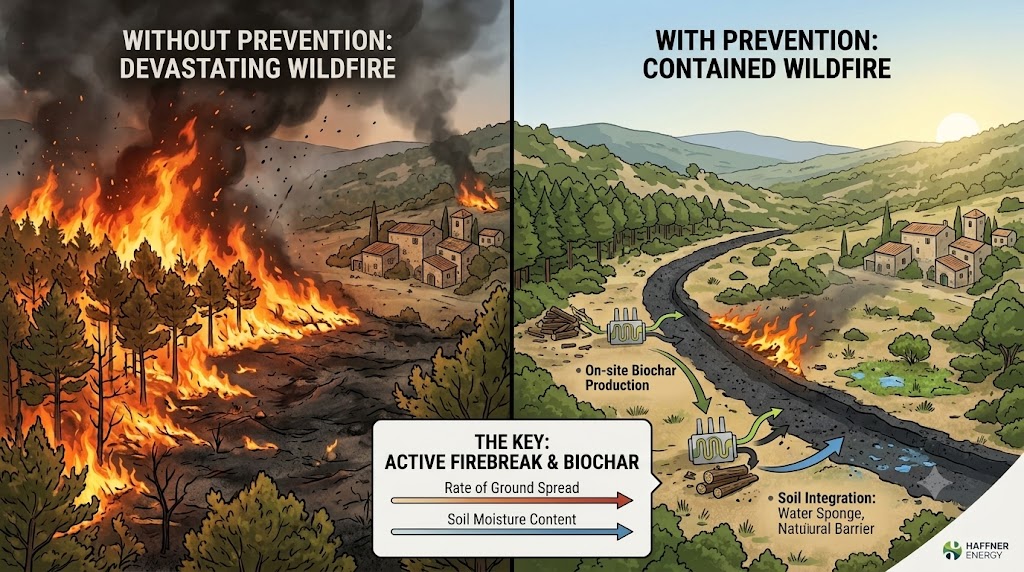
A Haffner module deployed in a high-risk forest area directly transforms dead wood and clearing residues into biochar on site. This biochar can then be redistributed back into the forest itself — and this is where a remarkable and little-known physical property comes into play:
Biochar does not burn easily.
Its porous carbonized structure, stripped of volatile compounds by thermolysis, gives it far greater fire resistance than natural wood. When integrated into forest soils, it reduces the spread of ground fires, creates buffer zones, and slows the progression of wildfires.
An Economic Model for Preventive Clearing
Today, clearing costs money. With a Haffner module, clearing generates revenue:
- The transformed biomass produces local energy (electricity, heat, hydrogen)
- The co-produced biochar generates tradable carbon credits
- The redistributed biochar in the forest reduces fire risk — avoiding much higher firefighting and reconstruction costs
Local authorities, the ONF (National Forest Office), and forest owners could be remunerated for this service through carbon markets and natural risk prevention funds (FPRNM). A payment for environmental services (PES) system tailored to this model is technically and legally feasible in France.
2. Soil Depollution: Biochar as a Natural Filter
Filtering Properties of Biochar
The porous structure of biochar (specific surface area of 200 to 400 m²/g) makes it an exceptional natural adsorbent. It captures and retains:
- Heavy metals: lead, cadmium, arsenic, mercury — particularly useful on polluted industrial soils and brownfields
- Pesticides and herbicides: adsorption of residual organochlorine molecules in intensive agricultural soils
- Hydrocarbons: fixation of petroleum residues on contaminated soils
- Nitrates: reduction of leaching into aquifers in agricultural areas
Concrete Applications
Industrial brownfields and ICPE sites: Spreading biochar on contaminated soils as a first step in depollution, reducing the bioavailability of pollutants before phytoremediation or excavation.
Over-treated agricultural zones: Biochar improves soil structure, retains water and nutrients, reduces the need for chemical inputs — while fixing pesticide residues.
Road and highway verges: Soils along roads accumulate heavy metals (brakes, tires, fuels). Biochar as a filtering layer protects adjacent aquifers.
Wetlands and watersheds: Spreading upstream to intercept agricultural pollutants before they reach waterways.
3. Revitalization of Degraded Soils: Biochar as a Soil Amendment
Revitalized Biochar: The Inoculation Principle
Biochar alone is biologically inert. But when revitalized — that is, loaded with microorganisms, nutrients, and organic matter before spreading — it becomes an exceptional amendment:
- Porous structure = ideal habitat for mycorrhizal fungi and beneficial bacteria
- Improved water retention of 20 to 40% depending on the soil
- Stabilized pH in acidic soils
- Slow release of nutrients over several years
This revitalization process is simple: the biochar is mixed with compost, plant slurry, or microbial extracts for 2 to 4 weeks before spreading. It can be done locally by farmers themselves.
Post-Fire Forest Soils
After a megafire, soils are sterile, impermeable (hydrophobic crust), and prone to erosion. Spreading revitalized biochar accelerates microbial recolonization, improves water infiltration, and reduces erosion — significantly shortening the forest regeneration timeline.
4. Physical properties and water management
A carbon and water sponge
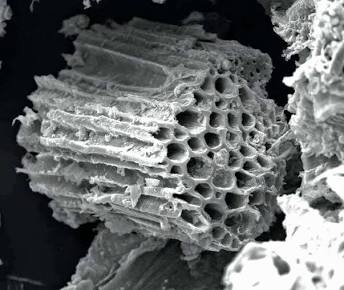
The microscopic porosity of biochar is the key to its multifunctional physical capabilities. This structure acts like a rigid sponge, capable of retaining not only carbon but also water and nutrients. A single gram of high-purity biochar can offer a specific internal surface area of several hundred square meters.
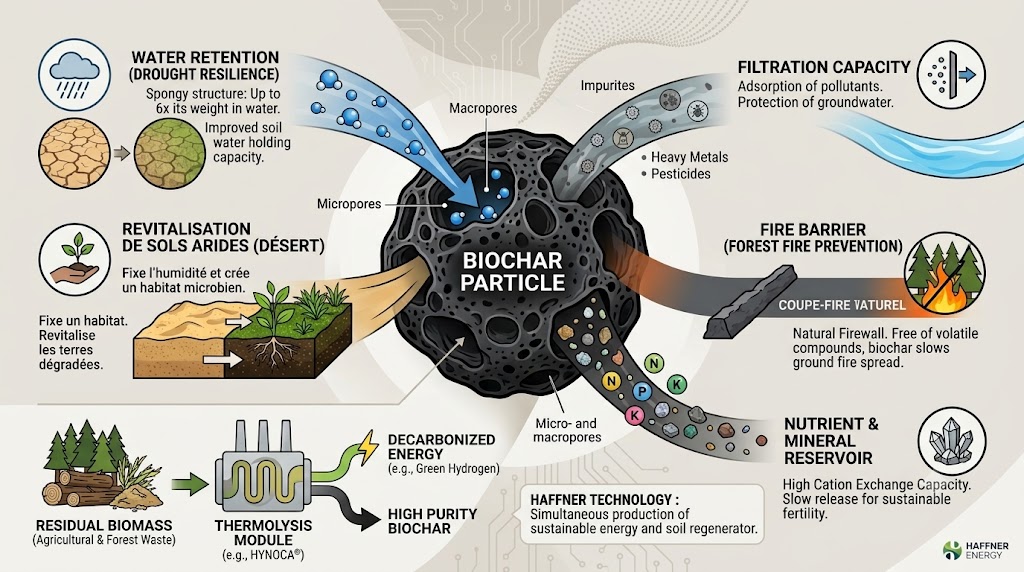
Integrating this material into the soil yields interconnected physical and ecological benefits:
- Drought retention: Water is captured via capillary action within the micro-pores and remains available to roots, reducing irrigation needs by nearly 50% and revitalizing arid or desert soils.
- Mineral and nutrient reservoir: It retains mineral complexes (NPK) and prevents leaching, stabilizing long-term fertility.
- Wildfire deterrent: By maintaining higher residual soil moisture and being devoid of volatile matter itself, biochar slows the advance of the fire front along the ground.
Haffner technical note: A major strategic development in Haffner’s technology involves designing modules capable of capturing—in addition to biochar—the water co-produced during biomass thermolysis. This water, resulting from the high-temperature dehydration of plant tissues, is of extreme purity. Its direct recovery opens up unprecedented prospects for water autonomy at production and supply sites for water-stressed areas.
5. A Model of Payment for Environmental Services
Available Financial Flows
| Service Provided | Payment Mechanism | Estimated Value |
|---|---|---|
| Carbon sequestration | Carbon credits (CORC) | 110-140 €/t CO₂ |
| Preventive clearing | FPRNM funds + local authorities | Variable |
| Soil depollution | PES markets + ADEME | Variable |
| Agricultural soil improvement | CAP, agro-environmental aid | Variable |
| Reduction of fire damage | Insurance + disaster funds | Indirect |
A Key Player: Haffner as a Territorial Service Operator
A Haffner module deployed in a forest or agricultural area does more than produce energy. It becomes a territorial environmental service operator: it collects residual biomass, produces energy and biochar, and redistributes this biochar in the form of paid services (fire prevention, depollution, soil amendment) remunerated through multiple mechanisms simultaneously.
It is a decentralized, multi-revenue model that is unsubsidized at its energy core and creates local, non-relocatable jobs. The solution’s negative carbon footprint—validated at -12 kg of net CO₂ per kg of hydrogen produced based on 2023 data—has been significantly optimized through the latest module upgrades, now reaching a potential of -20 kg of CO₂ per kg of H₂ produced.
Conclusion: Biochar, a Lever for a Territorial Circular Economy
Biochar is not a by-product to be buried. It is a strategic, multifunctional material that:
- Sequesters carbon for centuries
- Protects forests against fires
- Cleans soils polluted by heavy metals and pesticides
- Revitalizes lands degraded by intensive agriculture
- Generates revenue through carbon markets and PES
Every Haffner module deployed simultaneously produces decarbonized energy and a tool for territorial regeneration. This is the very definition of a complete circular economy.
Linkedin: Eric Jacob
Basic private research @ | Multiple Degrees in Physical Measurements | Energy transition advisor