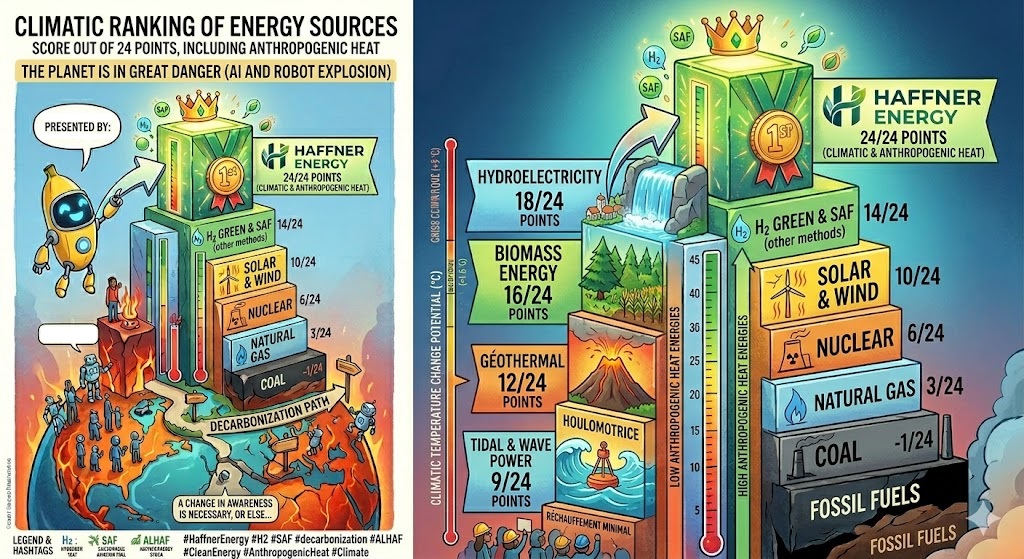
CLIMATE RANKING OF ENERGY SOURCES (French version - FR)
Scoring out of 24 points — Anthropic Heat Included
📥 Consult the Manifesto for Technological Sovereignty and Resilience
📥 Global comparison of energy sources: HAFFNER ENERGY changes everything
📥 Hydrogen independence within reach of every region, community, and rural elected official
Independent Technical Note — EJS — June 2026
Methodology — 6 criteria × 4 points max = 24 pts
| Criterion | Weighting | Description |
|---|---|---|
| 🏭 Sovereignty | /4 | Geopolitical dependence on imports |
| ♻️ Non-CO₂ | /4 | Zero CO₂ emissions in operation |
| 🌱 Decarbonizes | /4 | Actively sequesters existing atmospheric CO₂ |
| 💨 Air | /4 | Zero fine particles, NOx, SOx |
| 🌍 Soils | /4 | Zero or positive impact on soils and water |
| 🌡️ Net Heat | /4 | Zero anthropic heat added to the atmosphere |
Note on anthropic heat: Any stock energy (fossil, nuclear) adds net heat to the Earth’s envelope, independently of CO₂.
Flow energies (solar, wind, hydropower) intercept energy already present in the natural cycle — they do not add net heat.
Haffner Energy is the only system that reduces dissipated heat by sequestering the carbon that was blocking its evacuation into space.
| # | Energy Source | 🏭 Sov. | ♻️ CO₂ | 🌱 Decarb. | 💨 Air | 🌍 Soils | 🌡️ Heat | 📊 /24 |
|---|---|---|---|---|---|---|---|---|
| 1 | 🇫🇷 Haffner H4/S-iC ⏳ | 4 | 4 | 6★ | 4 | 4 | 4★ | 24+★⏳ |
| 2 | 🇫🇷 Haffner H6/C-iC (+ biochar) | 4 | 4 | 6★ | 4 | 4 | 4★ | 24+★ |
| 3 | Tidal / Wave | 4 | 4 | 0 | 4 | 4 | 4 | 18 |
| 4 | Onshore Wind | 3 | 4 | 0 | 4 | 4 | 4 | 17 |
| 5 | Offshore Wind | 3 | 4 | 0 | 4 | 3 | 4 | 16 |
| 6 | Solar PV | 3 | 4 | 0 | 4 | 3 | 4 | 16 |
| 7 | Solar CSP | 3 | 4 | 0 | 4 | 3 | 4 | 16 |
| 8 | Hydropower | 4 | 4 | 0 | 4 | 3 | 4 | 16 |
| 9 | Geothermal | 4 | 4 | 0 | 4 | 3 | 3 | 15 |
| 10 | White Hydrogen (natural) | 3 | 4 | 0 | 4 | 3 | 3 | 15 |
| 11 | Nuclear Fusion (ITER) | 3 | 4 | 0 | 4 | 4 | 2 | 15 |
| 12 | Biogas / Methanization | 4 | 2 | 1 | 3 | 3 | 3 | 13 |
| 13 | Green Hydrogen (electrolysis) | 3 | 4 | 0 | 4 | 3 | 1 | 13 |
| 14 | Conventional Biomass | 4 | 2 | 1 | 2 | 3 | 3 | 12 |
| 15 | e-SAF (electrolysis + FT) | 3 | 4 | 0 | 4 | 3 | 1 | 12 |
| 16 | Nuclear (existing amortized fleet) | 3 | 4 | 0 | 4 | 2 | 1 | 12 |
| 17 | New EPR2 Nuclear | 3 | 4 | 0 | 4 | 2 | 1 | 12 |
| 18 | Clean Coal (CCS) | 2 | 2 | 2 | 2 | 2 | 1 | 10 |
| 19 | 1G Biofuels (rapeseed/maize) | 4 | 2 | 0 | 2 | 2 | 2 | 9 |
| 20 | Blue Hydrogen | 2 | 2 | 0 | 2 | 2 | 1 | 7 |
| 21 | Natural Gas (CCGT) | 2 | 1 | 0 | 2 | 2 | 0 | 6 |
| 22 | Grey Hydrogen | 2 | 1 | 0 | 2 | 2 | 0 | 6 |
| 23 | Fuel Oil (backup) | 1 | 0 | 0 | 1 | 1 | 0 | 3 |
| 24 | Oil | 1 | 0 | 0 | 1 | 1 | 0 | 3 |
| 25 | Coal | 1 | 0 | 0 | 0 | 1 | 0 | 1 |
Legend
| Symbol | Meaning |
|---|---|
| ★ | Exceeds theoretical maximum — net positive effect on climate |
| ⏳ | Performance data not yet disclosed to the market |
| 🇫🇷 | French technology |
What This Ranking Reveals
Conventional renewable energies top out at 15-18/24 — they do not decarbonize; they only limit new emissions.
Nuclear drops to 12/24 despite its excellence on CO₂: the fatal heat dissipated into rivers (2 GW thermal for 1 GW electric across a fleet of 56 reactors) and radioactive waste with no permanent solution in France heavily penalize the score.
Haffner H6 exceeds the 24-point maximum — the only system with a net positive effect on the climate, which sequesters existing carbon instead of simply avoiding new emissions.
The H4/S-iC, currently under development, aims for the same level with significantly higher efficiency and a substantially lower unit cost — data not yet disclosed to the market.
Independent Technical Note — EJS — June 2026.
The author is an individual shareholder and does not act on behalf of the company mentioned.
This text does not constitute investment advice.
License: Creative Commons Attribution-NoDerivatives 4.0 International (CC BY-ND 4.0)
LinkedIn: Eric JacobBasic private research @ | Multiple Degrees in Physical Measurements | Energy transition advisor