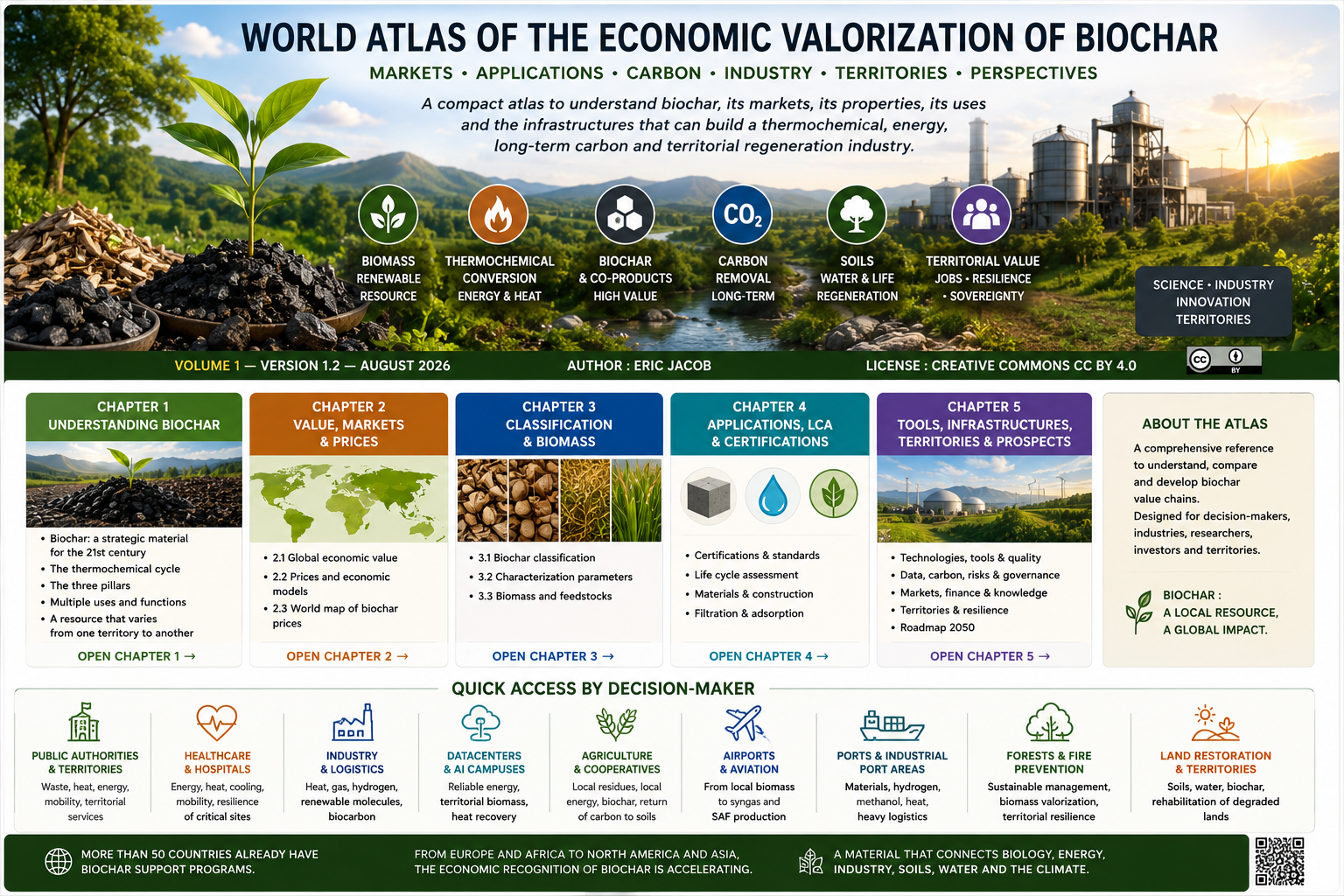
WORLD ATLAS OF THE ECONOMIC VALORIZATION OF BIOCHAR
Markets • Applications • Carbon • Industry • Territories • Outlook
Volume 1 — Version 1.2 — August 2026 Author: Eric Jacob License: Creative Commons CC BY 4.0
A deliberately compact atlas designed to explain biochar, its markets, properties, applications, and the infrastructures that can structure a thermolysis, energy, durable-carbon, and territorial-regeneration value chain.
Read the Atlas
| Chapter | Topic | Access |
|---|---|---|
| 1 | Understanding biochar | Open |
| 2 | Value, markets and prices | Value and markets |
| 3 | Classification and biomass | Classification |
| 4 | Applications, LCA and certifications | Certifications |
| 5 | Tools, infrastructure, territories and outlook | Building tomorrow’s value chain |
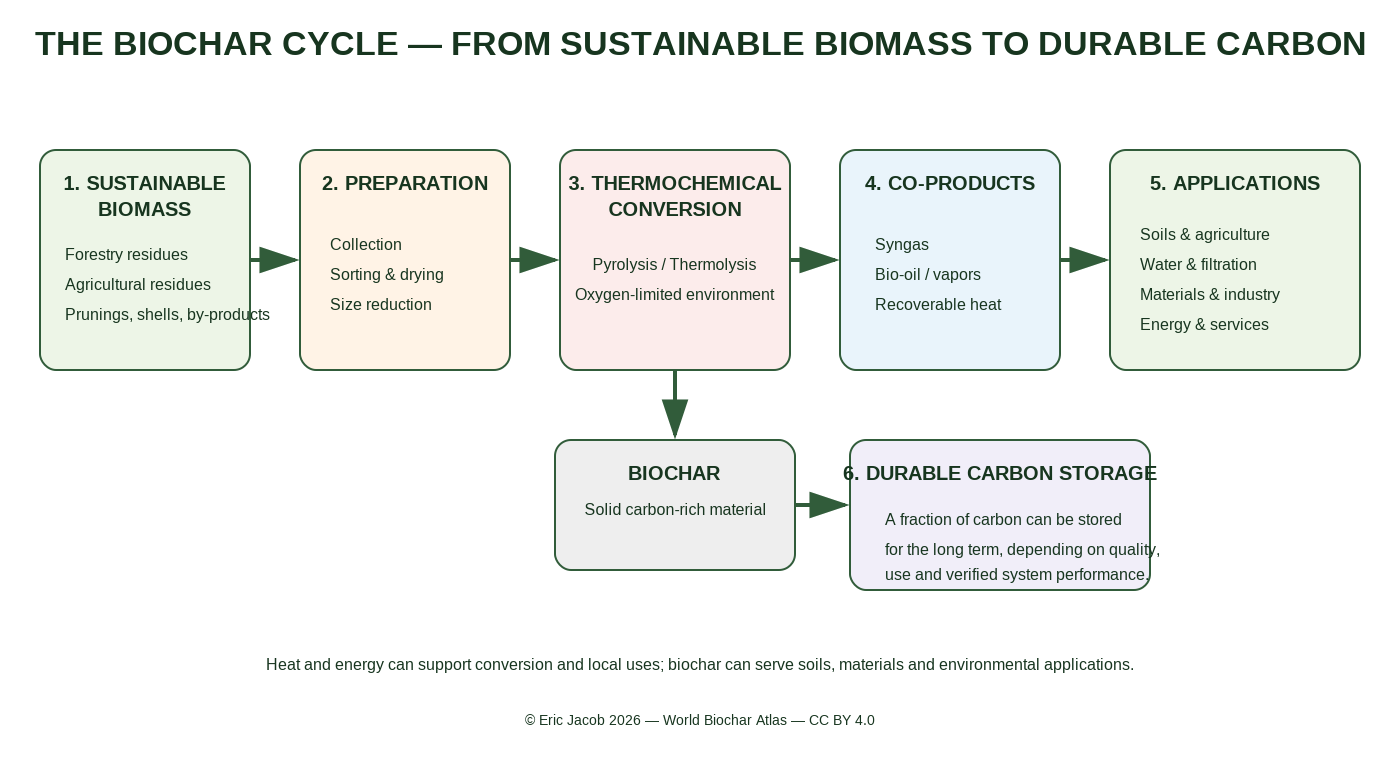
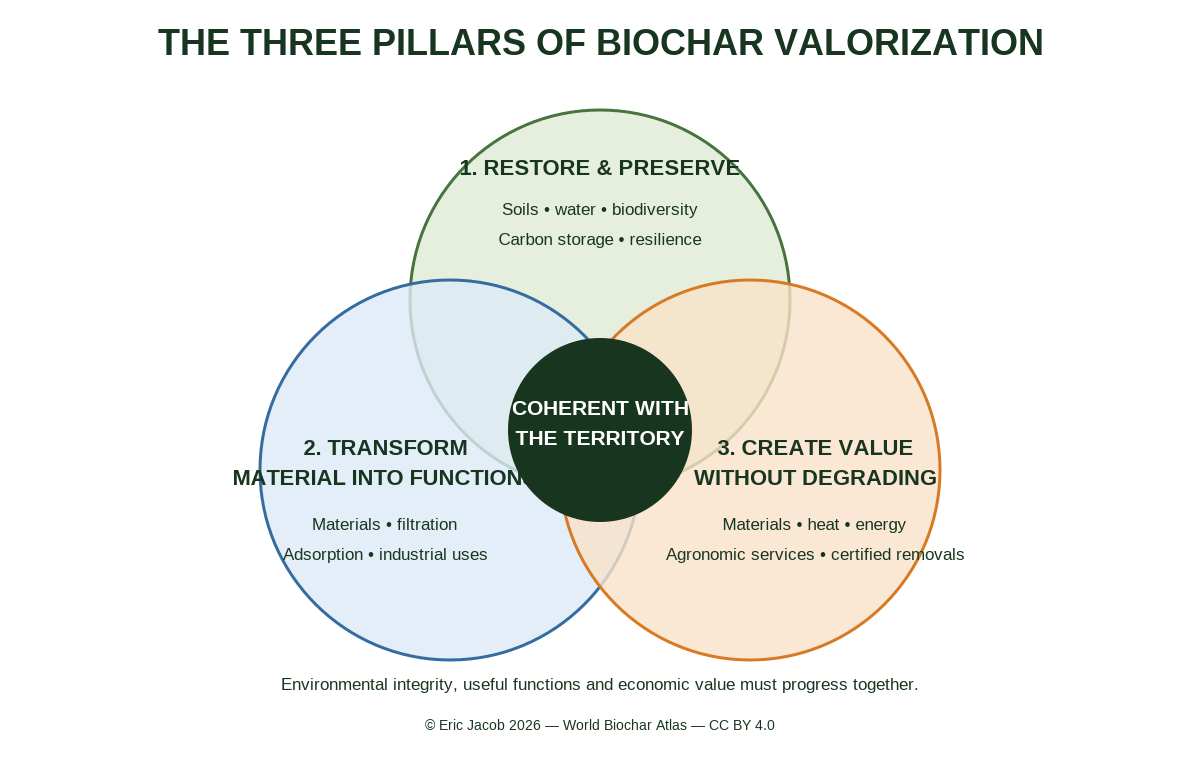
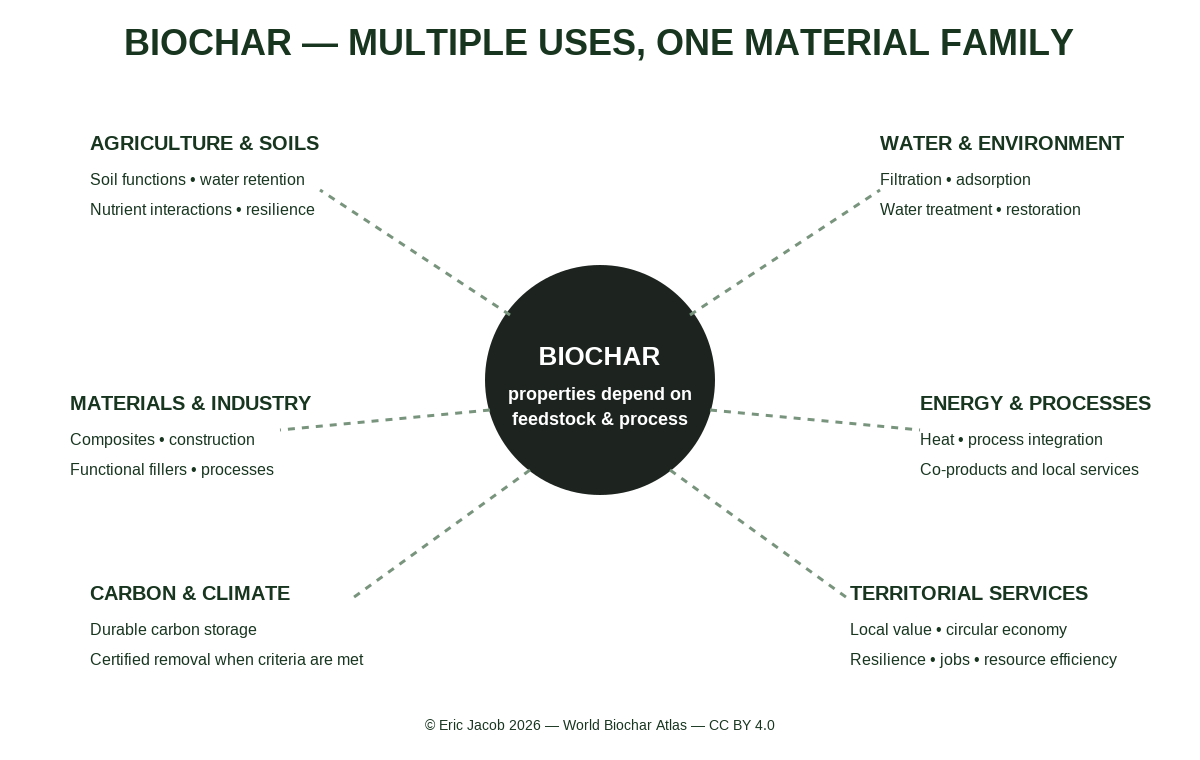
Chapter 1 — Understanding Biochar
Chapter 2 — Value and Global Markets
- 2.1 — The Global Economic Value of Biochar
- 2.2 — Prices and Economic Valorization
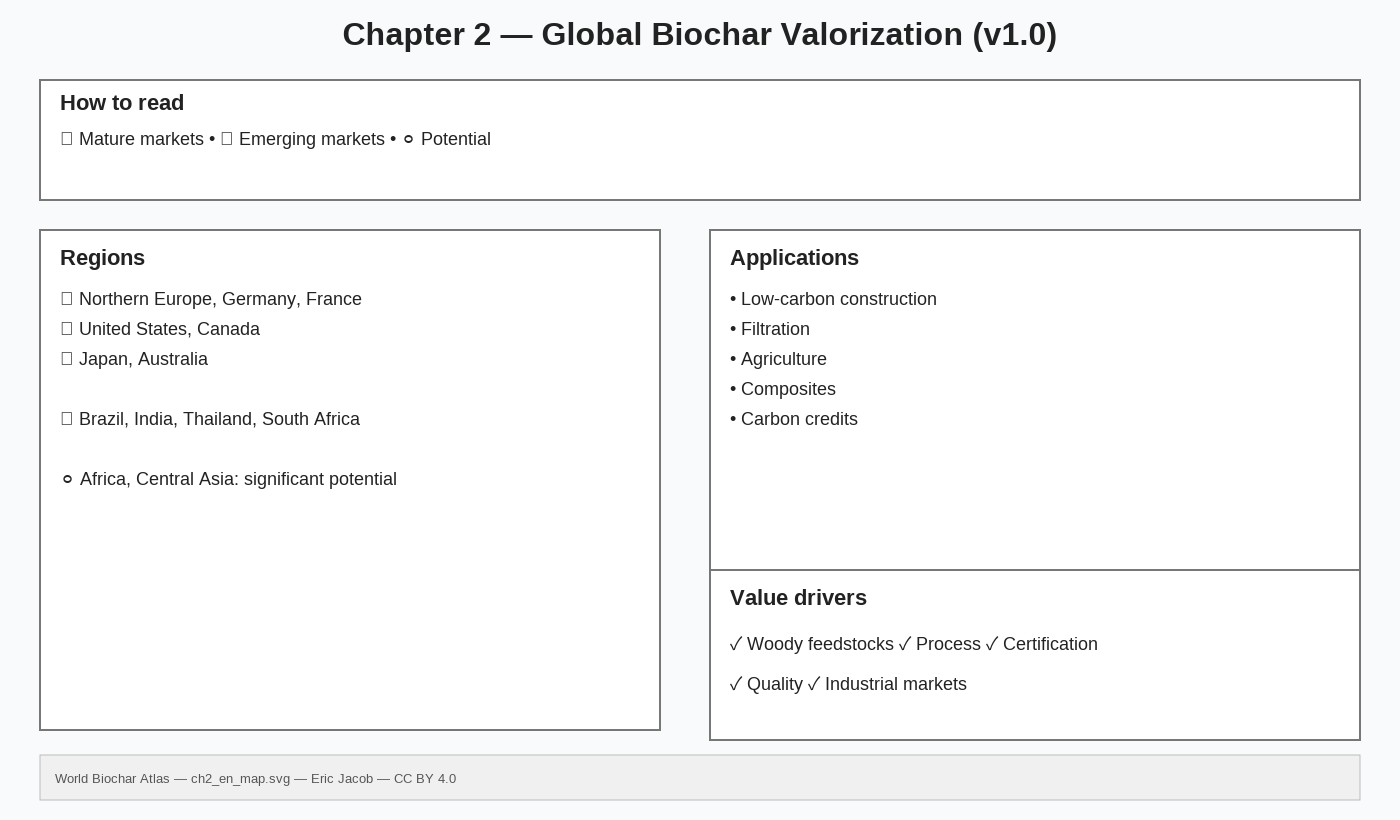
- 2.3 — World Map
Chapter 3 — Characterize Before Use
- 3.1 — Biochar Classification
- 3.2 — Characterization Parameters
- 3.3 — Biomass and Feedstocks
Biochar is not a uniform product: the feedstock, process, and production parameters determine its properties and therefore its possible applications.
Chapter 4 — Applications and Assurance
Chapter 5 — Building Tomorrow’s Value Chain
Technologies, quality and applications
Measurement, data, carbon and risks
Markets, governance and knowledge
Territories and outlook
Quick Access by Decision-Maker
Are you looking for practical ways to apply thermolysis, biochar, or energy valorization to your activity?
The Territories & Resilience chapter turns the main sectors into use cases: available resources, energy requirements, valuable products, decarbonization, and value creation.
Territories & Public Services
-
Local Authorities & Metropolitan Areas Green waste, heat, energy, mobility, and territorial services.
-
Hospitals & Healthcare Infrastructure Energy, heat, cooling, mobility, and resilience for critical sites.
-
District Heating & Real Estate Valorizing territorial biomass as close as possible to thermal demand.
-
Defense & Isolated Sites Energy autonomy, logistics resilience, and reduced dependencies.
Industry, Digital Infrastructure & Logistics
-
Industries Heat, gas, hydrogen, renewable molecules, and biocarbon.
-
Wholesale Markets, Distribution & Logistics Turning residues, pallets, and territorial flows into energy and services.
-
Data Centers & AI Campuses Dispatchable energy, territorial biomass, and heat valorization.
-
Ports & Industrial-Port Zones Materials, hydrogen, methanol, heat, fuels, and heavy logistics.
Agriculture, Food & Living Territories
-
Agriculture & Cooperatives Mobilizable residues, local energy, biochar, and returning carbon to soils.
-
Food Industry & Cold Chain Valorizing co-products and biomass to produce heat, cooling, and energy.
-
Forests & Wildfire Prevention Creating value from biomass generated through sustainable forest management.
-
Restoring Degraded Lands Biochar, water, soils, and restoration strategies for vulnerable territories.
Mobility & Renewable Molecules
-
Airports & Aviation From territorial biomass to syngas and then to SAF pathways.
-
Hydrogen, Methanol, Biomethane & Fuels Choosing the molecule that genuinely replaces fossil expenditure.
ESG, Carbon & Investment
-
ESG / Sustainability Directors Turning an industrial project into demonstrable carbon reduction.
-
Biochar or Energy Yield? Understanding the trade-off between energy production and retained solid carbon.
-
Carbon, MRV & Metrology Measuring, documenting, and making carbon performance verifiable.
-
Financiers & Investors Assessing savings, multiple revenue streams, CAPEX/OPEX, and economic robustness.
Can’t find your exact activity? Start with the 8-question method: identify your residues, the biomass available around your site, your energy expenditure, and the products or services your territory could use.
How to Read the Figures
The main infographics are displayed directly in the articles. When an SVG version provides additional value — map, diagram, flow chart, or scientific figure — it is offered separately.
Atlas figures carry the attribution:
© Eric Jacob 2026 — World Biochar Atlas — CC BY 4.0
Method
Wherever possible, the Atlas distinguishes between:
- established data;
- orders of magnitude;
- observations and field feedback;
- characteristics announced by manufacturers;
- industrial assumptions;
- prospective architectures.
When industrial data remain ambiguous, the Atlas keeps that uncertainty visible rather than inventing false precision. Technical and commercial specifications must be checked against the version in force at the time a project is developed.
Biochar is not presented as a universal solution: its value depends on biomass origin, process, quality, final use, territory, and life-cycle assessment.
Citation
Eric Jacob, World Atlas of the Economic Valorization of Biochar, Volume 1, version 1.2, 2026.
An evolving project published on GitHub Pages. Articles can be read independently while remaining connected to the Atlas.
License: Creative Commons CC BY 4.0