Chapter 5 — Restoring Degraded Lands: Biochar, Water and Territorial Regeneration
World Atlas of the Economic Valorization of Biochar — Volume 1
Version 1.1 — August 2026 · Author: Eric Jacob
← Buyer’s Guide · ↑ Atlas Contents · Territories & Resilience →
Regenerating Soils, Water, Life and Territories
Desertification and land degradation are not a single problem and do not have a universal solution. They result from varying combinations of climate, erosion, loss of organic matter, agricultural practices, pressure on water resources, salinization, wildfires, deforestation, overexploitation or land abandonment.
Biochar therefore does not mechanically “green” a desert. However, in appropriate soils, climates and agronomic systems, it can become one component of a broader strategy combining restoration of organic matter, vegetation cover, water management, composts, agroforestry and the circular economy.
The challenge extends beyond amending an individual plot. It consists of organizing a territorial loop in which selected local biomass resources are transformed through thermolysis into biochar and useful energy flows, then reintegrated into an economy that progressively restores its soils.
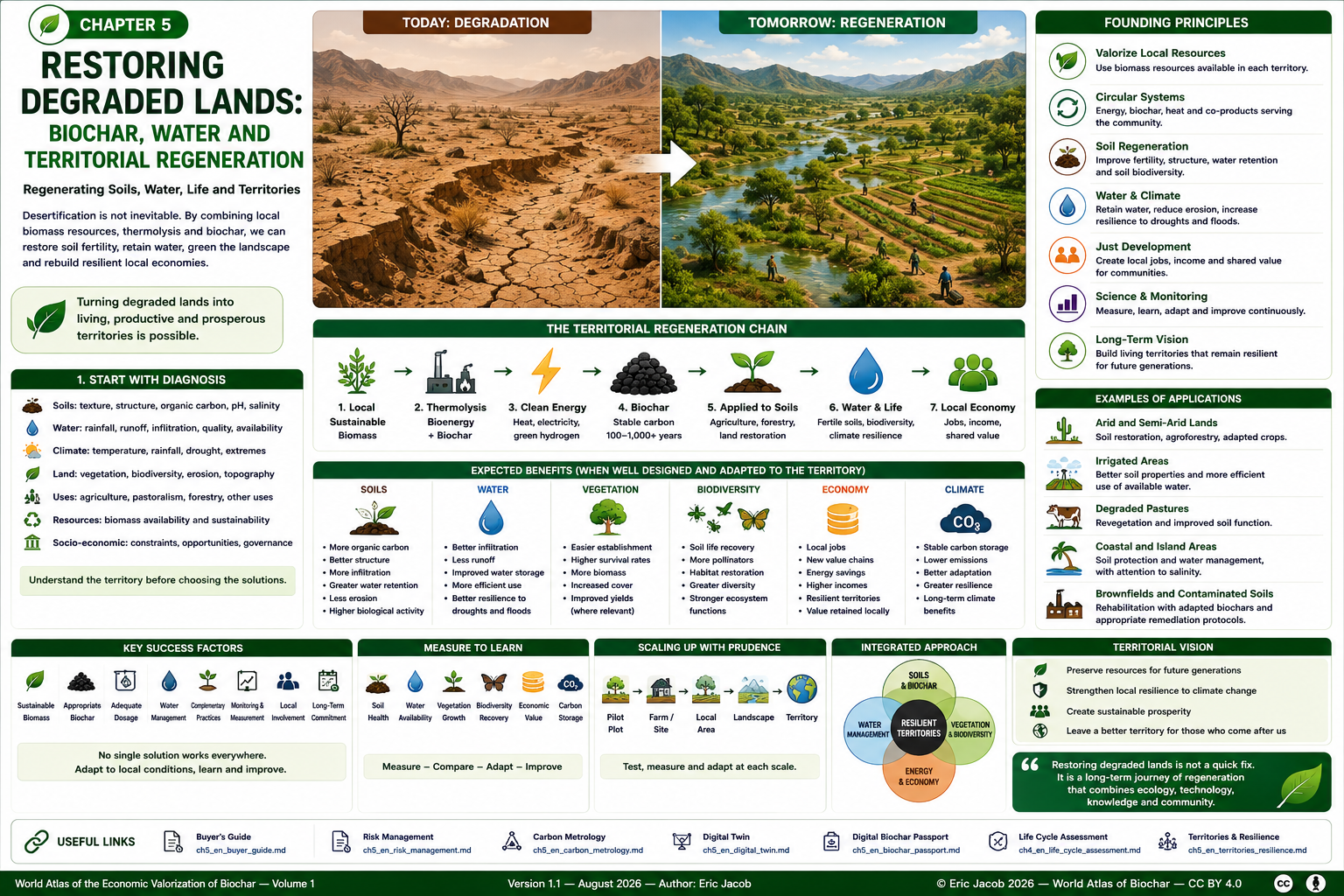
Figure 1 — Restoring degraded lands: from degraded land to regenerated territories.
The infographic illustrates a prospective architecture. Actual performance depends on the soil, climate, biochar, application rate, water availability and management practices. Any numerical values shown are illustrative and should not be interpreted as universal performance levels.
© Eric Jacob 2026 — World Atlas of Biochar — CC BY 4.0.
1. Restoration Begins with Diagnosis
Before applying biochar, it is necessary to understand why the territory is degrading.
The diagnosis may include:
- soil texture and structure;
- organic carbon;
- pH;
- salinity;
- water-holding capacity;
- infiltration and runoff;
- wind and water erosion;
- climate and rainfall;
- existing vegetation;
- biodiversity;
- water resources;
- agricultural and pastoral uses;
- actual biomass availability;
- economic and social constraints.
The objective is not to begin with a technological solution and then search for a problem to justify it.
The correct sequence is:
TERRITORY
    ↓
DIAGNOSIS
    ↓
CAUSES OF DEGRADATION
    ↓
AVAILABLE RESOURCES
    ↓
POSSIBLE SOLUTIONS
    ↓
PILOT PROJECT
    ↓
MEASUREMENT
    ↓
ADAPTATION
2. Biomass Must Remain Sustainable
Land restoration cannot be based on degrading another ecosystem to obtain biomass.
Priority should be given, depending on local conditions, to resources such as:
- agricultural residues that can genuinely be removed sustainably;
- pruning residues;
- sustainably managed forestry residues;
- certain non-food biomass residues;
- husks, shells and pits;
- biomass generated through landscape maintenance;
- selected local by-products;
- perennial biomass where its production is ecologically appropriate.
A resource being physically present does not mean that all of it is available.
Part of the biomass may need to remain in place to:
- protect soils;
- maintain organic matter;
- preserve habitats;
- recycle nutrients;
- reduce erosion.
The sustainable fraction must therefore be assessed territory by territory.
3. The Territorial Regeneration Chain
The conceptual chain can be represented as follows:
LOCAL SUSTAINABLE BIOMASS
          ↓
COLLECTION AND PREPARATION
          ↓
THERMOLYSIS
          ↓
 ┌────────┴────────┐
 ↓                 ↓
USEFUL ENERGY    BIOCHAR
 ↓                 ↓
LOCAL USES       SOILS
                   ↓
             WATER + ROOTS
                   ↓
              VEGETATION
                   ↓
             BIODIVERSITY
                   ↓
        TERRITORIAL RESILIENCE
The value of the system lies in the combination of functions.
The same territorial infrastructure can potentially contribute to biomass management, energy production, soil restoration and local economic activity.
4. Water Is Often the Limiting Factor
In arid and semi-arid territories, improving soil properties is insufficient if plants do not have access to enough water to establish themselves.
A restoration strategy must therefore examine:
- rainfall;
- runoff;
- infiltration;
- evaporation;
- irrigation where appropriate;
- soil-water storage;
- groundwater constraints;
- water quality;
- competition between uses.
Biochar may modify water retention and soil structure under certain conditions, but the effect depends strongly on the product and soil.
It must therefore be measured locally rather than assumed.
The relevant objective is not:
“Does biochar retain water?”
but:
“Does this biochar, at this dose, in this soil and under this climate, improve useful water availability sufficiently to justify its use?”
5. Biochar Is Not Used Alone
A degraded soil may simultaneously lack:
- organic matter;
- nutrients;
- biological activity;
- vegetation cover;
- structure;
- water;
- protection against erosion.
Biochar cannot necessarily correct all these limitations.
It may therefore be combined, according to the situation, with:
BIOCHAR
   +
COMPOST / ORGANIC MATTER
   +
VEGETATION COVER
   +
AGROFORESTRY
   +
WATER MANAGEMENT
   +
ADAPTED AGRONOMIC PRACTICES
The objective is to rebuild a functioning soil system rather than simply add a carbonaceous material.
6. The Biochar Must Match the Soil
There is no universal “desert biochar.”
A suitable product depends on factors including:
- pH;
- ash content;
- salinity;
- particle size;
- porosity;
- carbon content;
- stability;
- nutrients;
- contaminants;
- intended use.
For example, adding a highly alkaline biochar to an already strongly alkaline soil may be inappropriate.
Likewise, a biochar containing undesirable concentrations of salts or contaminants should not be applied merely because the soil is degraded.
The principles developed in the Biochar Quality Index and the Buyer’s Guide therefore remain applicable.
7. Application Rates Must Be Tested
The appropriate dose depends on:
SOIL
+ BIOCHAR
+ CLIMATE
+ CROP / VEGETATION
+ WATER
+ OTHER AMENDMENTS
+ ECONOMIC OBJECTIVE
More biochar does not automatically mean a better result.
Pilot plots can compare several rates with an untreated control.
For example:
CONTROL
BIOCHAR — LOW RATE
BIOCHAR — INTERMEDIATE RATE
BIOCHAR — HIGHER RATE
The exact rates must be selected according to the project rather than copied from an unrelated experiment.
8. From the Plot to the Landscape
A successful experiment on a few square metres does not automatically justify deployment across thousands of hectares.
Scaling up introduces additional questions:
- biomass volumes;
- transport;
- spreading equipment;
- water;
- workforce;
- financing;
- logistics;
- monitoring;
- land tenure;
- biodiversity;
- social acceptance.
The progression should therefore remain controlled:
LABORATORY
    ↓
PILOT PLOT
    ↓
FARM / SITE
    ↓
LOCAL AREA
    ↓
LANDSCAPE
    ↓
TERRITORY
At each stage, results should be measured before moving to the next scale.
9. Measuring Restoration
The success of a restoration project should not be measured by the number of tonnes of biochar applied.
Indicators can include:
Soil
- organic carbon;
- aggregation;
- infiltration;
- useful water retention;
- erosion;
- pH;
- salinity;
- biological activity.
Vegetation
- establishment rate;
- biomass;
- crop yield where relevant;
- plant survival;
- vegetation cover;
- root development.
Water
- irrigation requirements;
- runoff;
- infiltration;
- soil moisture;
- water quality where relevant.
Biodiversity
- vegetation diversity;
- soil organisms;
- insects;
- fauna;
- habitat recovery.
Economy
- agricultural income;
- energy savings;
- jobs;
- avoided costs;
- value of biochar and co-products;
- local value retained within the territory.
A successful project is therefore multidimensional.
10. Controls and Baselines
A project should document its initial state.
Without a baseline, it becomes difficult to know whether an observed improvement results from:
- biochar;
- rainfall;
- irrigation;
- compost;
- changes in agricultural practices;
- natural recovery;
- another intervention.
Whenever possible:
INITIAL STATE
      ↓
CONTROL AREA
      +
TREATED AREA
      ↓
REPEATED MEASUREMENTS
      ↓
COMPARISON
This approach transforms an attractive landscape transformation into documented evidence.
11. Time Matters
Some effects can appear rapidly.
Others may require years.
Monitoring can therefore distinguish:
SHORT TERM
establishment, moisture, initial crop response

MEDIUM TERM
soil structure, vegetation, biological activity

LONG TERM
carbon stability, ecosystem development,
resilience and territorial transformation
The restoration of degraded land is not a one-season industrial performance test.
It is a long-term process.
12. Carbon Must Be Measured Separately
A greener landscape and durable carbon storage are related objectives, but they are not the same measurement.
The carbon chain must remain explicit:
BIOCHAR MASS
      ↓
DRY MASS
      ↓
CARBON CONTENT
      ↓
DURABLE CARBON ESTIMATE
      ↓
LIFE-CYCLE BALANCE
      ↓
VERIFICATION / CERTIFICATION
The methodology is developed in Carbon Metrology.
A restoration project should not automatically convert every tonne of biochar applied into an equivalent quantity of certified atmospheric carbon removal.
13. Life Cycle Assessment
A project may appear regenerative locally while creating excessive impacts elsewhere.
The Life Cycle Assessment should therefore consider, according to the chosen system boundary:
- biomass collection;
- preparation;
- drying;
- transport;
- thermolysis;
- energy consumption;
- emissions;
- biochar transport;
- application;
- co-products;
- reference scenario.
Transporting low-density biomass over very long distances simply to create a “local” restoration project may undermine part of the environmental logic.
14. Avoiding Competition for Food and Ecosystems
A regeneration project should not create a new pressure on:
- food production;
- forests;
- natural habitats;
- water resources;
- fertile land.
Dedicated biomass production may be relevant in some situations, but only after considering:
- land availability;
- water;
- biodiversity;
- food competition;
- alternative uses;
- complete environmental balance.
The objective is regeneration, not displacement of degradation.
15. Salinity Requires Special Attention
Many degraded and arid soils are affected by salinity.
Biochar is not a universal desalination treatment.
The project must characterize:
- soil salinity;
- irrigation-water salinity;
- biochar mineral composition;
- ash;
- soluble salts;
- drainage;
- evapotranspiration.
A biochar unsuitable for a saline environment can worsen rather than solve the problem.
16. Erosion and Vegetation Cover
Water and wind erosion can remove fine soil particles and organic matter faster than they can be rebuilt.
Restoration strategies may therefore combine biochar with:
- permanent or seasonal cover;
- hedges;
- agroforestry;
- contour management;
- windbreaks;
- mulching;
- erosion-control structures;
- adapted grazing management.
The carbonaceous amendment is then one element within a physical and biological protection system.
17. Agroforestry and Perennial Vegetation
Trees, shrubs and perennial crops can provide several functions:
ROOTS
→ SOIL STRUCTURE

CANOPY
→ SHADE + MICROCLIMATE

BIOMASS
→ ORGANIC MATTER

VEGETATION
→ BIODIVERSITY

PRODUCTION
→ FOOD / FIBRE / OTHER PRODUCTS
Where appropriate, biochar may help support establishment, while the vegetation itself progressively becomes the principal engine of regeneration.
The long-term objective is therefore not permanent dependence on repeated biochar applications.
It is the reconstruction of a more self-sustaining living system.
18. Local Energy Can Finance Regeneration
Thermolysis can potentially produce useful energy flows in addition to biochar.
Depending on the process and project configuration, these may contribute to:
- heat;
- electricity;
- renewable gas;
- hydrogen or other molecules through additional conversion stages.
The important economic idea is that restoration does not necessarily have to rely on a single source of revenue.
BIOMASS MANAGEMENT
        ↓
THERMOLYSIS
        ↓
ENERGY + BIOCHAR
        ↓
REVENUES / SAVINGS
        ↓
LOCAL INVESTMENT
        ↓
SOIL AND TERRITORIAL RESTORATION
The actual technical and economic balance must be established project by project.
19. Creating Local Value
A territorial project can potentially generate activity through:
- biomass collection;
- logistics;
- operation and maintenance;
- laboratories;
- biochar conditioning;
- agricultural services;
- application;
- monitoring;
- research;
- local energy services.
The relevant question is not simply how much value the installation creates, but how much of that value remains within the territory.
20. From Restoration to Productive Landscapes
Restoration does not necessarily mean returning every territory to an imagined historical state.
Depending on ecological and social objectives, regenerated land may support:
- agriculture;
- agroforestry;
- pasture;
- forestry;
- biodiversity areas;
- watershed protection;
- mixed landscapes.
The intended future state should be defined before the intervention.
A restored territory must remain compatible with its water resources, climate and ecosystems.
21. Several Possible Applications
Potential contexts include:
Arid and Semi-Arid Land
Soil restoration, agroforestry and adapted crops.
Irrigated Areas
Improving soil properties and seeking better use of available water.
Degraded Pastures
Re-establishing vegetation and improving soil function where appropriate.
Coastal and Island Areas
Soil protection and water management, with particular attention to salinity.
Brownfields, Mine Spoils and Contaminated Soils
Potential rehabilitation using specifically characterized biochars and appropriate remediation protocols.
In contaminated environments, biochar application must never be assumed to make contaminants disappear.
22. Biodiversity Is Not an Optional Co-Benefit
A territory cannot be considered regenerated solely because agricultural production increases.
The project should also consider:
- habitats;
- soil life;
- pollinators;
- native vegetation;
- ecological corridors;
- water systems;
- landscape diversity.
The objective is not merely to produce more biomass.
It is to restore the capacity of the territory to remain productive and alive.
23. Social Conditions
Restoration projects affect people who already live on and use the territory.
Planning should therefore consider:
- land rights;
- pastoral uses;
- farming practices;
- access to water;
- local employment;
- distribution of revenues;
- knowledge and traditions;
- governance.
A technically successful project that excludes local communities can become territorially unsustainable.
24. A Territorial Digital Twin
The Digital Twin can help connect:
SOILS
+ WATER
+ BIOMASS
+ ENERGY
+ BIOCHAR
+ CROPS
+ CLIMATE
+ ECONOMY
It can be used to compare scenarios before large-scale deployment.
But the model must remain connected to field measurements.
A digital simulation cannot demonstrate that a restoration strategy works until real observations confirm it.
25. The Digital Passport
The Digital Biochar Passport can link each batch to:
- its biomass;
- its production process;
- its analyses;
- its carbon characteristics;
- its application site;
- its date;
- its subsequent monitoring.
This creates a traceable relationship between the material applied and the results observed years later.
26. Risk Management
Restoration projects can fail.
Possible causes include:
- unsuitable biochar;
- excessive application rate;
- insufficient water;
- salinity;
- contaminants;
- poor biomass sourcing;
- excessive transport;
- inappropriate crop choice;
- lack of maintenance;
- weak governance;
- inadequate financing.
These risks should be identified before deployment.
See Risk Management.
27. Start Small, Measure, Then Expand
A prudent deployment strategy is:
DIAGNOSE
    ↓
CHARACTERIZE
    ↓
TEST
    ↓
MEASURE
    ↓
COMPARE
    ↓
ADAPT
    ↓
EXPAND
This approach is slower than announcing the immediate transformation of millions of hectares.
It is also much more credible.
28. From Degraded Land to Territorial Infrastructure
Once biomass, energy, soil and water flows are considered together, the same reasoning can extend beyond agricultural restoration.
Potential consumers and partners may include:
- villages;
- towns;
- metropolitan areas;
- hospitals;
- industries;
- logistics platforms;
- district-heating networks;
- major energy consumers;
- data centers.
Thermolysis can then potentially become a multi-service territorial infrastructure: valorizing selected biomass resources, producing biochar, supplying useful energy flows and creating local loops of materials and value.
This is the subject of the next chapter:
Territories & Resilience: From Biochar to Territorial Infrastructure.
Conclusion
The restoration of degraded land will only be sustainable if ecology and economics cease to be considered separately.
A well-designed territorial loop can simultaneously seek to:
PRESERVE RESOURCES
+ VALORIZE SELECTED BIOMASS
+ PRODUCE USEFUL ENERGY
+ RETURN STABLE CARBON
+ IMPROVE SOILS
+ SAVE WATER
+ CREATE LOCAL VALUE
+ MEASURE RESULTS
The vision developed in this part of the Atlas is therefore not that of a technology that single-handedly “saves” a desert.
It is the vision of territories progressively recovering water, soils, vegetation, biodiversity and an economy capable of sustaining that regeneration over time.
Figure and Associated Documents
- Infographic — Restoring Degraded Lands
- Risk Management
- Buyer’s Guide
- Carbon Metrology
- Digital Twin
- Digital Biochar Passport
- Life Cycle Assessment
- Territories & Resilience
← Buyer’s Guide · ↑ Atlas Contents · Territories & Resilience →
World Atlas of the Economic Valorization of Biochar — Eric Jacob — Version 1.1 — August 2026
License: Creative Commons CC BY 4.0
License: Creative Commons CC BY 4.0