Executive Summary: Energy Sovereignty & Industrial Resilience
Opportunity Brief – For public policymakers and regional investors
The Situation: The Dead End of Centralized Models
Energy and industrial infrastructure faces two major bottlenecks:
- The Thermodynamic Risk of Electrolysis: Mass hydrogen production via electrolysis competes directly with widespread electrification and the surging demand from AI-linked data centers. Furthermore, it dissipates anthropogenic heat without providing a carbon sink.
- The Illusion of Nuclear Solutions and White Hydrogen: Although promoted for their low initial carbon footprint, nuclear sectors and white (natural) hydrogen extraction suffer from a systemic thermodynamic flaw. They inject ever-increasing amounts of energy and anthropogenic heat into the system without offering any carbon sink. Amidst a trend of continuously rising energy demand, these solutions fail to prevent global warming: as long as legacy CO₂ saturates the atmosphere and acts as a locked-in greenhouse, any new thermal energy produced remains trapped within the Earth’s envelope.
- Financial Predation on Innovation: Listed SMEs developing disruptive technologies (specifically those eligible for PEA-PME schemes) are subjected to aggressive short-selling via dilutive financing instruments (such as OCEANE/BSA bonds), destroying their industrial capacity before deployment can even begin.
The Solution: Decentralized Cascading Biomass Thermolysis
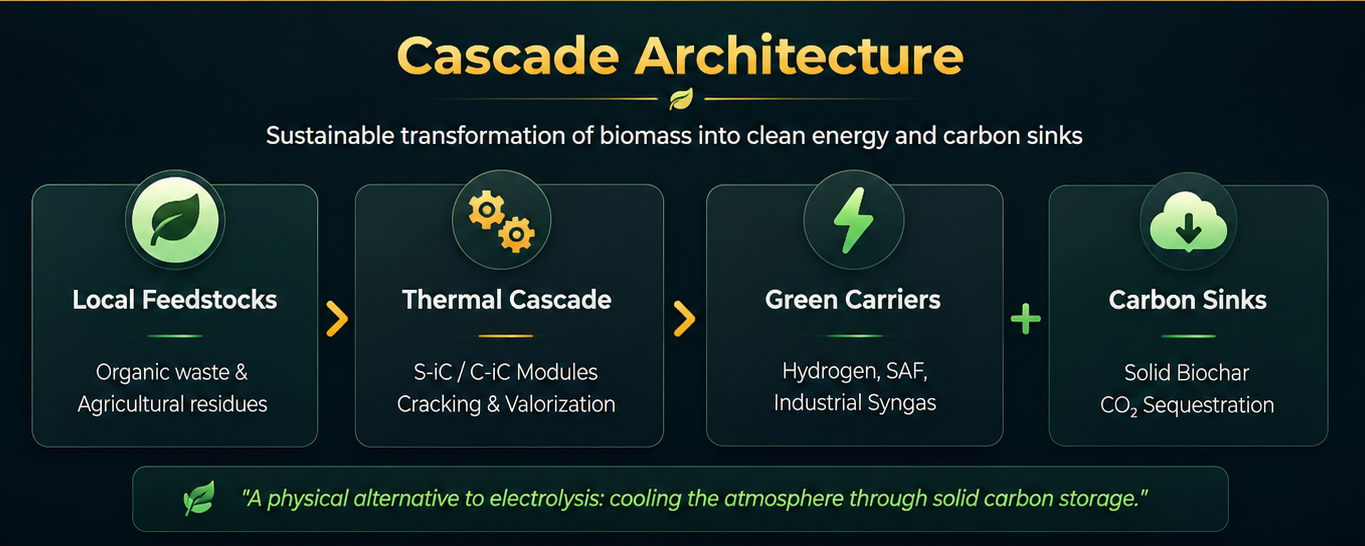
The alternative relies on a mature French technological breakthrough that requires little seed capital compared to centralized models, is immediately ready for industrialization, and offers an extremely rapid return on investment. Designed as mobile modules that can be relocated at any time, the system is installed in just 2 to 3 weeks on a simple asphalt surface—requiring neither foundations nor building permits—thereby decisively breaking the inertia associated with traditional infrastructure projects. This technology replaces fossil hydrocarbons with green energy carriers that capture massive amounts of CO₂ through a process combining the decentralized thermal conversion of organic residues and local biomass with a cascaded thermal coupling architecture. Thanks to the versatility of its syngas output, it enables the synthesis of a full range of petroleum-derived products.
Fundamental principles & overall performance
- Multi-feedstock flexibility: Valorization of local residual biomass and organic waste streams, featuring high tolerance for moisture and feedstock variability.
- Flexible energy carriers: High-efficiency generation of cost-competitive local syngas (estimated at ~€0.035/kWh), high-purity green hydrogen (99.97%), or synthetic aviation fuels (e-SAF).
- Negative emissions profile: Co-production of high-purity solid biochar. This co-product permanently sequesters biogenic carbon in the soil, transforming the industrial unit into an active carbon sink.
- Subsidy-free profitability: The target net cost of hydrogen ranges from €0.00/kg to less than €2.00/kg—depending on the opportunity cost of the biomass—made possible by the combined value of the energy produced and the carbon credits associated with the biochar.
Strategic advocacy objectives
- Financial shield: Establish a sovereignty-focused anti-dilution fund to prohibit toxic financing mechanisms and safeguard the equity of our high-potential listed energy companies.
- Implementation of a regulatory fast-track: Reduce administrative and zoning approval processes (ICPE) to under three months for the deployment of these mobile, decentralized modules (such as those developed by Haffner Energy) in the immediate vicinity of critical infrastructure (hospitals, logistics hubs, agricultural cooperatives).
- Regional momentum: Enable local elected officials and industrial zones to regain control over their waste management policies and energy costs, independently of centralized grids.
License: Creative Commons Attribution-NoDerivatives 4.0 International (CC BY-ND 4.0)
LinkedIn: Eric JacobBasic private research @ | Multiple Degrees in Physical Measurements | Energy transition advisor