Chapter 5 — Industrial Perspectives: Toward a New Carbon Economy
World Atlas of the Economic Valorization of Biochar — Volume 1
Version 1.2 — August 2026 · Author: Eric Jacob
← Chapter 4 — Filtration · ↑ Atlas Contents · Ideal Biochar →
Biochar could become one of the strategic materials of the industrial transition by combining long-term carbon storage, circular economy and renewable energy production.
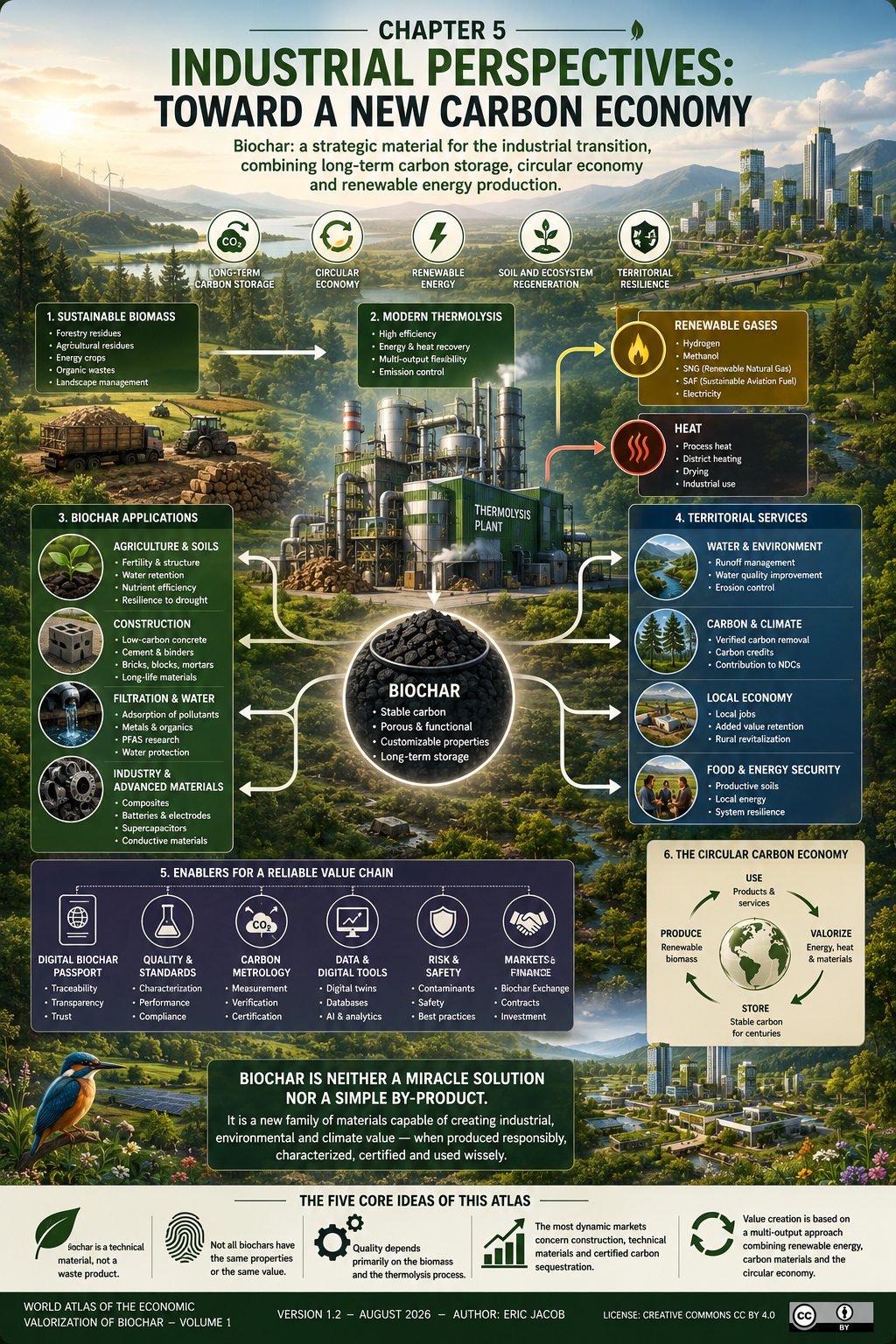
An Industrial Transformation
For a long time, thermolysis facilities were primarily designed to produce energy.
Market developments are now leading these facilities to be considered as multi-output valorization units capable of simultaneously producing:
- renewable gases;
- carbon-based materials;
- heat;
- environmental services.
This diversification is one of the main drivers of value creation.
An Economy with Multiple Revenue Streams
A modern facility can generate several complementary economic flows.
                Biomass
                    │
                    ▼
              Thermolysis
                    │
     ┌──────────────┴──────────────┐
     ▼                             ▼
 Renewable gases                Biochar
     │                             │
     ▼                             ▼
Hydrogen                    Construction
Methanol                    Agriculture
SNG                         Filtration
SAF                         Industry
     │                             │
     └──────────────┬──────────────┘
                    ▼
            Economic value
This diversification can potentially reduce dependence on a single market, although profitability depends on local conditions, operating costs and available outlets.
The Most Promising Sectors
Construction
The development of low-carbon concrete probably represents one of the largest potential markets of the coming decades.
Cement
The incorporation of carbon-based materials into certain binders is currently the subject of extensive research.
Agriculture
Biochar remains an interesting tool for improving certain soils, particularly when combined with appropriate agronomic practices.
Filtration
The adsorptive properties of biochar open up opportunities in the treatment of water, effluents and certain gases.
Advanced Materials
Research is developing in:
- composites;
- batteries;
- electrodes;
- supercapacitors;
- conductive materials.
These applications remain emerging but could represent high-value markets.
An Opportunity for Industrial Decarbonization
Unlike many climate solutions, biochar acts simultaneously on several levers:
- biomass valorization;
- waste reduction;
- long-term carbon storage;
- substitution for more emission-intensive materials;
- renewable energy production.
This multifunctional approach explains the growing interest from industry.
The Case of Modern Thermolysis Technologies
The latest industrial technologies seek to optimize simultaneously:
- energy efficiency;
- syngas quality;
- biochar quality;
- heat recovery;
- flexibility of end markets.
Depending on industrial choices, the same platform can supply several value chains: renewable hydrogen, methanol, SNG, SAF, heat or carbon-based materials.
Economic performance will nevertheless depend on numerous parameters: biomass quality, process efficiency, investment costs, market access and the regulatory framework.
General Conclusion
Biochar is neither a miracle solution nor merely a co-product of thermolysis.
It represents a new family of materials capable of simultaneously creating industrial, environmental and climate value.
Its development will depend on four essential conditions:
- sustainable and traceable biomass;
- controlled industrial processes;
- recognized certifications;
- markets capable of valuing its properties.
In this context, biochar could become one of the pillars of a circular economy based on the valorization of biogenic carbon.
The Five Essential Ideas of This Atlas
✅ Biochar is a technical material, not a waste product.
✅ Not all biochars have the same properties or the same value.
✅ Quality depends primarily on the biomass and the thermolysis process.
✅ The most dynamic markets today concern construction, technical materials and certified carbon sequestration.
✅ Value creation is based on a multi-output approach combining renewable energy, carbon-based materials and the circular economy.
“Carbon is not merely a waste product to be eliminated. When stabilized, certified and intelligently valorized, it becomes a strategic resource serving the industrial transition.”
Continue Reading
← Chapter 4 — Filtration · ↑ Atlas Contents · Ideal Biochar →
World Atlas of the Economic Valorization of Biochar — Eric Jacob — Version 1.2 — August 2026
License: Creative Commons CC BY 4.0
License: Creative Commons Attribution 4.0 International (CC BY 4.0)